戒烟后1个月口腔变化详解
In the first week after quitting, gum bleeding suddenly increases -- is it worsening or recovering?
From dry and sticky to suddenly abundant, the 30-day changes in saliva are far more complex than you think.
Taste begins to change within 48 hours, but this improvement can also bring unexpected trouble.
Oral ulcers, bad breath fluctuations -- these easily overlooked pitfalls are worth knowing in advance.
A ready-to-follow oral care checklist for the one-month quitting milestone.
One month of quitting does not mean your mouth is repaired, but it is enough to confirm one thing.
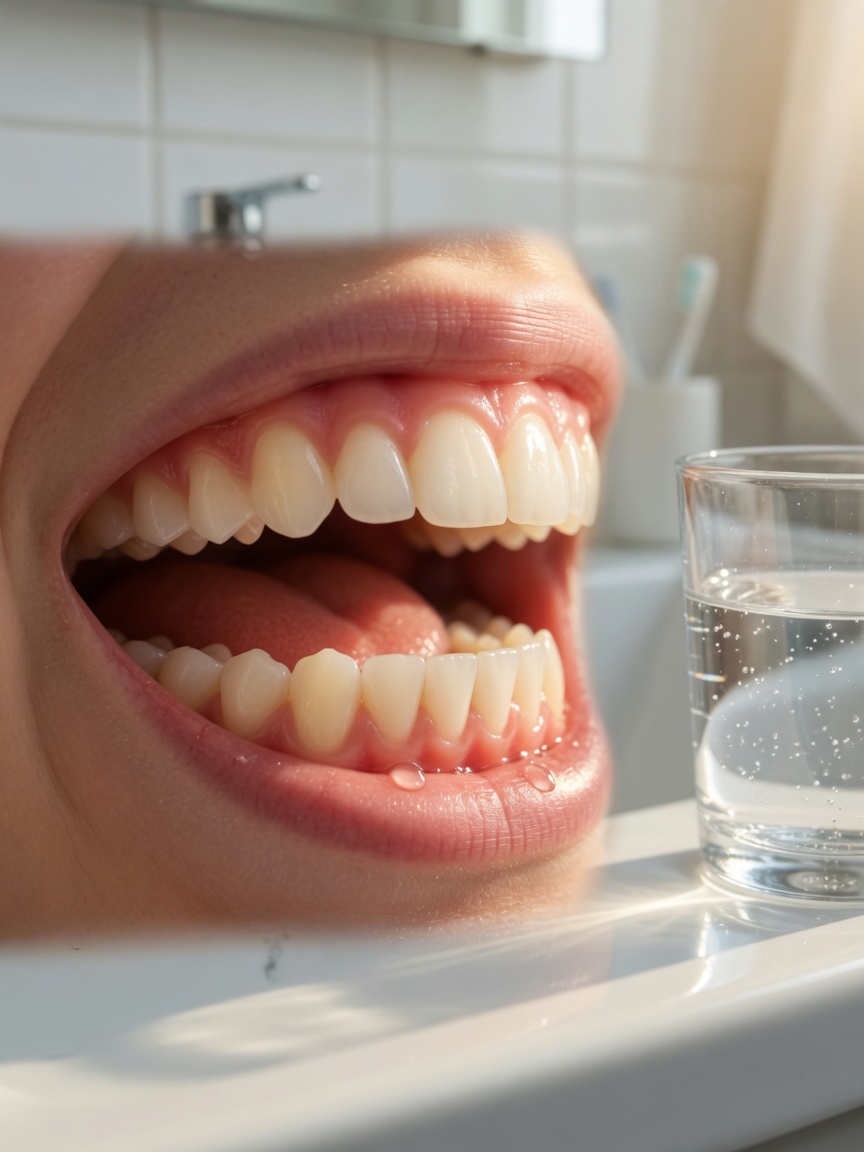
Detailed Explanation of Oral Changes 1 Month After Quitting Smoking
On the night of the 30th day after quitting smoking, I stood in front of the bathroom mirror at home, using my phone's flashlight to look at my gums for nearly five minutes. It wasn't vanity — it was because the pink foam I spat out while brushing in the first week scared me; in the second week, my sense of taste suddenly became "overloaded," and the bowl of plain noodle soup downstairs at the office, which I used to find bland, was now so salty it shocked me; in the third week, my saliva became sticky and abundant, like a film constantly coating my mouth. These aren't the kind of "everything gets better after quitting" clichés you find online — they are the real pitfalls I experienced on the oral front after 11 years of smoking, peaking at a pack and a half a day.
Many people focus on "will my periodontal health improve after a year" or "will my oral cancer risk drop in ten years." I wrote this article focusing only on the <strong>one-month mark after quitting</strong>. The reason is practical: in these 30 days, changes in gums, saliva, and taste are most concentrated, most easily misinterpreted, and most likely to cause relapse because of "mouth discomfort." Below I break it down into three sections, along with my own care practices and judgments.
I. Gums: They Got "Worse" in Week 1, But It Actually Means Blood Flow Is Returning
My Actual Timeline
- Morning of day 3 after quitting**: Brushing the inside of my lower front teeth with a soft-bristle toothbrush, the spit came out pink. When I smoked, I almost never bled — not because my gums were healthy, but because nicotine kept the gum blood vessels constricted, suppressing inflammation.
- Days 5–10**: Peak bleeding. Two nights when I flossed between my molars, the floss had a little dark red on it. I searched Baidu for "should I relapse if my gums bleed after quitting," and half the comments said "it's normal recovery" while the other half said "it means your periodontal disease has exploded" — extremely confusing information.
- Around day 14**: Bleeding frequency dropped. Brushing still occasionally showed pink, but not like the first week when "every brush turned pink."
- Day 28**: I went to a chain dental clinic in the west of the city for a scaling (cleaning). The dentist probed a few shallow pockets and said: "Your gum reaction now is closer to the real state than when you were smoking. Bleeding means blood supply is recovering. Next steps depend on cleaning and plaque control."
How to Understand This "Getting Worse"
When smoking, tobacco components weaken the gum's inflammatory response to plaque while reducing local blood flow. You think "no bleeding = healthy," but it's actually <strong>symptoms being masked</strong>. After quitting, circulation improves, oxygen and immune cells reach the gum tissue again, and existing gingivitis/early periodontal problems "surface": bleeding while brushing, bleeding on probing, and sometimes slightly swollen gum margins in the morning.
Multiple oral health educational resources and clinical observations mention that increased gum bleeding shortly after quitting does not mean the condition is worsening — it means the tissue is beginning to have a normal response. If you relapse out of fear, you're essentially "closing off" the blood vessels again, temporarily masking symptoms while the disease continues.
My personal view is clear: <strong>Increased gum bleeding within 1 month is mostly "recovery noise," not "a sign that quitting failed."</strong> What truly requires vigilance is: bleeding that persists more than 4–6 weeks without improvement, accompanied by noticeable tooth looseness,markedly worsening gum recession, or persistent dull pain — at that point, don't just "bear it," see a periodontist for evaluation.
What I Actually Did for Gum Care in the First Month
- **Switched to a soft-bristle toothbrush**. In week 2, I threw away the medium-bristle brush I'd used for half a year and switched to a small-head soft-bristle brush, deliberately lightening the pressure — like "applying toothpaste" rather than "scrubbing a pot."
- **Changed flossing from "occasional" to "every night on lower teeth"**. I relaxed the requirement for upper teeth first, focusing on stabilizing themost easily bleeding lower front interdental spaces.
- **No aggressive whitening, no baking soda brushing, no scraping the tongue root to the point of gagging in the first month**. The gums are "recalibrating" — don't add chemical and mechanical irritation on top.
- **Scheduled a scaling in week 4**. For long-term smokers, tartar is often under the gum line. Brushing alone can't remove it. After my scaling, my gums were sensitive for two days, but by day 3 bleeding was significantly less than before scaling — the benefit exceeded my expectations.
- Sugar-free gum / sugar-free lozenges**: Chew 5–10 minutes before meetings to stimulate saliva and replace the "empty hand" feeling of not holding a cigarette. Choose xylitol-based, not sugary ones.
- Water tracking**: Note "3 cups morning, 3 cups afternoon" in my phonememo — more useful than the empty phrase "drink more water."
- Limit strong tea and coffee 2 hours before bed**: In week 2 I tried downing an Americano at 8 p.m., and my mouth was dry at night plus my heart raced and gums were more sensitive.
- Nasal breathing**: People with rhinitiseasily sleep with their mouths open, the drier the sleep. I also used saline nasal rinse during this period, and my oral dryness decreased accordingly — oral issues sometimes need to be managed from the nasal side.
- **Metallic / bitter taste**: Common during blood flow and saliva changes, usually fades.
- **Hypersensitivity to spices, onions, garlic**: Previously needed heavy oil and spice for sensation, now light dishes are flavorful enough.
- **Residual smoke taste**: Especially in the morning,possibly from tongue coating and periodontal environment, not purely "lungs still expelling smoke."
- **Taste linked to mood**: When irritable, nothing tastes good, or you want to eat everything — this is the brain's reward system fluctuating during withdrawal, not entirely the tongue's doing.
- Wrote "food tastes better" as a quitting benefit**,instead of focusing only on gum bleeding discomfort.
- In weeks 2–4, deliberately arranged light but layered foods**: boiled egg + a pinch of salt, cold cucumber salad, steamed fish — let my taste practice "richness under low stimulation" rather than relying on spicy snacks and milk tea to fill the hand addiction.
- Recorded 3 "flavors I rediscovered after quitting"**. I wrote: the rice fragrance of plain congee, the sourness of apple skin, and the chlorine taste in tap water I never noticed before (the last one is annoying, but it shows my smell is waking up too).
- Brush with soft-bristle toothbrush morning and evening for 2 minutes each, light pressure.
- Evening flossing at least for lower front teeth and lower molar contacts.
- Lightly scrape tongue coating once (from back to front).
- Write down water intake goal, drink evenly throughout the day, don't chug it all at night.
- When needed: sugar-free gum to stimulate saliva; choose a gentle mouthwash and don't replace brushing.
- Look in the mirror at gum color and margins: changing from dull red/swollen to pink and firm is good.
- Recall bleedingfrequency this week: should show a downward trend; if still heavily bleeding every day in weeks 3–4, schedule a dentist appointment.
- Check if you're using spicy heavy snacks to "suppress the hand addiction" — this hinders mucosal repair.
- **One professional scaling** (if you have periodontitis history, follow the dentist's recommendations for more systematic basic treatment).
- **One self-baseline record**: years of smoking, daily cigarette count, current bleeding status, dry mouth score (0–10), taste sensitivity (0–10). Re-evaluate at the one-month mark and you'll see a curve instead of relying on anxiety.
- **Don't let nutrition collapse**: leafy greens, eggs, milk, beans, fresh fruit; no need for expensive supplements, just eat proper meals.
- Gum bleeding accompanied bysignificantly tooth looseness, weak bite
- Facial swelling, fever, limited mouth opening
- Ulcer > 2 weeks without healing, or white/red patch-like changes
- Severe dry mouth affecting swallowing and speech, persisting without relief
- Taste loss (not hypersensitivity, but everything tastes flavorless)persists
- Gums: Most people are still moving from "symptom exposure" to "inflammation control"; severe periodontal problems cannot turn around in 30 days.
- Saliva: Secretion and moisture are usuallysignificantly better than during smoking, but still affected by environment and nasal breathing.
- Taste: The "food tastes better" at the everyday diet level has mostly materialized; fine-area threshold recovery may still be ongoing.
- **If bleeding increases, first check cleaning and whether you need a dental cleaning — don't relapse first.**
- **More saliva and sharper taste are repair signals — use them to rebuild your eating rhythm, not just for compensatory eating.**
- **Getting a dental evaluation in the first month is more useful than buying ten more whitening toothpastes.**
A pitfall I fell into: In the first week, I used a mouthwash with a strong alcohol feel. My gums burned, and bleeding was moresignificantly that night. I later switched to an alcohol-free, gentle type, using it at most once a day, and rinsing with plain water afterward.
II. Saliva: From "Dry and Sticky" to "Suddenly Abundant," With a Strange Taste in Between
I Actually Had Chronic Dry Mouth While Smoking Without Knowing It
When smoking, nicotine and smoke interfere with saliva secretion and oral mucosal status. Many people live with mild dry mouth for years without realizing it. My standard routine used to be: drink half a glass of water upon waking, suck on a candy before speaking at meetings, otherwise my tongue would "stick" to my palate.
Saliva Changes in the 30 Days After Quitting (By Week)
<strong>Week 1: Dry and sticky coexist</strong>
Nicotine withdrawal begins to "unbind" salivary gland function, but the mucosa and glands don't reset overnight. I was still dry during the day, but at night Imore easily felt mucus in my mouth. Two mornings I woke up with a sour-bitter taste — not food-related,more like "stale oral residue." Some say their mouth still tastes like smoke after quitting — this is common: saliva composition and secretion rhythm are adjusting, plus old deposits on the tongue coating and in periodontal pockets, so the taste gets brieflydisrupted.
<strong>Week 2: Secretion increases quickly, breath getsdisrupted before clearing</strong>
Increased saliva is good: it buffers acid-base balance, washes away food debris, and helps dissolve taste molecules. But when secretion suddenly increases, if tartar and tongue coating aren't cleaned, breath might "get worse before getting better." On day 12, a colleague asked me "did you eat something strong?" when I'd only had black coffee that day. That night I started seriously scraping my tongue (gently from back to front, not digging hard), and the next day itsignificantly improved.
<strong>Weeks 3–4: Dry mouthsignificantly reduced, but still "episodic"</strong>
From 10 a.m. to noon, my saliva was at its best; after 3 p.m., if I sat long in air conditioning, I'd still feel dry. This shows saliva recovery isn't a "switch flipped to always on" — it's affected by water intake, air conditioning, how much you talk, and caffeine. By day 30, I was actively drinking about 1.5–2 liters of water daily, and dry mouth episodes dropped from "wanting to drink almost every hour" in week 1 to "occasionally remembering to drink."
Saliva-Related: Don't Mistake "Excess Saliva" for a Problem
Some people find "too much saliva" disgusting after quitting. I was annoyed at first too, but later realized: this is the gland moving from suppression toward normal. As long as there's no facial paralysis, lumps, or severe pain,first observe for 2–3 weeks while managing plaque and tongue coating. If severe dry mouth persists, investigate medications, Sjögren's syndrome, mouth-breathing due to rhinitis, etc. — don't simply blame it on "quitting side effects."
Practical Methods I Used
III. Taste: Starts Changing Within 48 Hours, But "Full Recovery" Isn't Overnight
How Research and Personal Experience Align
Smoking damages or dulls taste-related receptors; food often feels more "flat." After quitting, smell and taste often begin to show improvement within <strong>about 48 hours</strong>. Electrogustometry studies have found that the tongue tip and edges can approach non-smoker levels in about <strong>2 weeks</strong>, while the back and dorsal areas recover more slowly, sometimes taking weeks or longer.
This almost exactly matched my experience:
| Time | My Actual Sensation |
|---|---|
| Day 2 dinner | The sweetness of tomato scrambled eggs suddenly jumped out, like turning the volume from 3 to 7 |
| End of week 1 | Could clearly distinguish two different brands of green tea in the office pantry |
| Weeks 2–3 | Allergy-level sensitivity to bitter and smoky flavors; passing a barbecue stall made me nauseous |
| Week 4 | Sensitivity slightly subsided, entering a "clear but not sharp" state, eating more enjoyably andmore prone to hunger |
Taste recovery has a side effect: <strong>youmore prone to overeat andmore likely to crave sweets</strong>. My weight increased by 1.2 kg in week 3 — not metabolic mystery, but "food tastes better + hand-to-mouth substitution"combined. Few oral series articles mention this, but it directly affects whether you can stick with quitting — better taste is a reward, but also a trap.
Normal Manifestations of Taste "Chaos"
How I Used Taste Recovery to My Advantage
If taste remainssignificantly diminished after 1 month, or only a metallic taste persists and worsens, see a dentist or ENT specialist — don't endlessly self-attribute.
IV. Other "Extra Oral Conditions" You Might Encounter in the First Month
Beyond gums, saliva, and taste, I must add a couple of easily overlooked points:
<strong>Oral Ulcers</strong>
Clinical health education mentions that some quitters experience oral mucosal discomfort in weeks 1–4 after quitting, and ulcers are not uncommon. The triggers are often summarized as: immune fluctuations under withdrawal stress, dietary disruption leading to insufficient B vitamins/vitamin C/zinc, and changes in oral flora and cleaning habits. I myself got a rice-sized ulcer on my lower lip on day 9, which hurt for 4 days when eating. My approach was simple: avoid sour, spicy, hot foods; use topical ulcer treatments as directed; and eat proper meals instead of using snacks to suppress the hand addiction. If an ulcer doesn't heal after 2 weeks or appears in clusters, see a doctor — don't self-apply hormonal ointments.
<strong>Bad Breath Fluctuations</strong>
Tobacco-related bad breath will decrease after quitting, but if tartar, tongue coating, and periodontal pockets remain, bad breath won't automatically disappear. The first month is an overlapping period of "tobacco smell declining + periodontal truth surfacing" — don't simply cover it with gum.
<strong>Improved Response to Periodontal Treatment</strong>
This is good news: after quitting, gum response to professional treatment is usually better than when continuing to smoke. So doing a scaling and basic periodontal evaluation in the first month offers great value — don't wait until "bleeding completely stops," which could take a long time.
V. One-Month Quitting Anniversary: Oral Care Checklist (Ready to Follow)
Below is the executable version I tested from day 1 to day 30. It's not a perfect plan, but it's a version that <strong>can reduce relapse triggers</strong>.
Daily
Weekly
Recommended to Complete Within the First Month
When You Must See a Doctor (Don't Tough It Out)
VI. My Personal Judgment: Where Does the Mouth Stand at One Month?
First, a dose of cold water: <strong>One month after quitting does not mean your mouth is "repaired."</strong>
Now, some reassurance: <strong>One month is enough to confirm one thing — your body is moving.</strong> Gums will bleed, saliva will be disrupted for a while, taste will be hypersensitive — these "noises"exactly prove you are no longer in the state where nicotine suppressed blood vessels and sensation together. What I feared most wasn't the pink foam in week 1, but the ten years of "never bleeding" false calm while smoking.
If you can only remember three sentences:
When I turned off the bathroom light on day 30, I thought: the oral front won't automatically give you an award just because you quit, but it will honestlyrespond whether you continue to harm it. The next 2–3 months are the "payoff period" for gum texture, breath stability, and response to professional treatment. One month is not the finish line — it's just the first day you truly see the real condition of your mouth.
(This article combines the quitting oral recovery experience with publicly availablepopular science information and cannot replace an in-person consultation. If you already have periodontal disease, mucosal lesions, or systemic signs, please seek medical attention promptly.)
Key Takeaways
No bleeding while smoking does not equal healthy gums; it is actually masked symptoms
If bleeding increases, first check cleaning and dental scaling, do not relapse first
Taste recovery is a quitting benefit, but beware of compensatory eating
One month is not the finish line, but the starting point for seeing true oral condition